Blog
Product Recommendation Engine: How Does It Work?
A personalized recommendation engine provides users with individual item recommendations, allowing them to focus on content that matters to them....
A product recommendation engine uses behavior and catalog data to pick which products each shopper sees;
Most combine collaborative filtering, content-based filtering and real-time signals, with a fallback for new visitors;
Choose by catalog size, data quality, integrations and team capacity, and test against a control group;
For B2C stores with 1,000+ products, Aqurate combines AI recommendations with merchandising control and goes live within 24 hours.
A shopper opens a product page for a linen shirt. Under it, the store shows the same six best sellers it shows everyone: a winter coat, a phone case, a pair of boots. She goes back to search, types another query and leaves after two minutes.
Personalized product recommendation engines solve that moment by showing each visitor products that match what they're looking at and what they've done before. Below you'll find how these engines work, which data they need, how the main platforms compare and why Aqurate is the best fit for growing stores with large catalogs.
Chapters:
1. What is a product recommendation engine?
2. How do machine learning product recommendations work?
3. What types of recommendation engines exist, from collaborative filtering to real-time models?
4. What are the benefits of personalized product recommendation in e commerce?
5. What data do recommendation engines need?
6. Which cross-sell and upsell recommendation strategies work?
7. What are the common mistakes in product recommendation systems?
8. How do you choose the right product recommendation tool?
9. How do the best product recommendation engines for ecommerce compare?
10. Why is Aqurate the best choice for growing ecommerce stores?
11. How much does a recommendation engine cost?
12. Frequently asked questions about product recommendation engines
13. Recommendations that earn their place
A product recommendation engine is software that reads shopper behavior and catalog data and decides, in real time, which products to show each visitor. It places them on product pages, category pages, in the cart and in emails, so shoppers find relevant items without digging through filters.
To understand how product recommendation engines work, follow their three-step loop:
Collect signals: clicks, searches, purchases, time on page and current stock levels.
Interpret intent: models look for patterns across thousands of sessions and estimate what each shopper is likely to want.
Show products: the engine fills a homepage carousel, a cart upsell or an email block with the items most likely to interest that shopper.
The data shows why stores invest in this. A Salesforce analysis of more than 150 million shoppers found that visits where the shopper clicked a recommendation made up 7% of visits but 26% of revenue. Those shoppers were already more engaged, so the figure shows the value of the moment more than the exact effect of the widget.
Machine learning product recommendations improve over time because the model learns from what shoppers actually do. A rules-based widget always shows the same top sellers. A machine learning model studies what similar shoppers clicked, added to cart and bought, then updates its predictions as new data comes in.
The stronger platforms add semantic understanding, so the engine grasps what a search query or a browsing session means beyond matching keywords and tags. That lets an AI-driven product recommendation engine move from reacting to what a shopper viewed to anticipating what they're likely to want next.
Many engines also run several recommendation strategies at once, such as personalized picks, cross-sells, replenishment suggestions and trending items, and choose the one that performs best for each shopper and page. Retailers use AI for product recommendations because manual merchandising can't keep up with a catalog that changes daily and shoppers with very different intentions. For a wider view of where these engines fit among other tools, see Aqurate's overview of the top AI tools in eCommerce.
Most recommendation engines rely on three core approaches, collaborative filtering, content-based filtering and real-time behavioral models, and the mature platforms combine them. Visual AI adds a fourth layer for image-driven categories.
A collaborative filtering recommendation engine groups shoppers with similar behavior and recommends what others in the same group bought. A content-based recommendation engine for ecommerce looks at product attributes, such as category, material, color and price, and suggests items similar to what the shopper viewed. A real-time product recommendation system reacts to the current session, so suggestions change during the visit.
Approach | Strength | Weakness | Best fit |
|---|---|---|---|
Collaborative filtering | Finds non-obvious product pairs from shared behavior | Needs history, weak for new visitors and new products | Large catalogs with steady, returning traffic |
Content-based filtering | Works from the first visit and for new products | Depends on clean, detailed product data | Catalogs with rich attributes |
Real-time behavioral | Adapts to intent within a session | Needs a few interactions to start | Fast-changing intent, anonymous visitors |
Visual AI | Matches style and look | Limited value for non-visual products | Fashion, beauty, home decor |
Collaborative filtering struggles with the cold-start problem, when a shopper or product has no history yet. That's why content-based and real-time signals act as a fallback for first-time visitors, and why most retailers end up combining all three.
Personalized product recommendation in e commerce has become a baseline expectation for shoppers. In McKinsey's research on the value of getting personalization right, 71% of consumers said they expect companies to personalize interactions, and 76% said they get frustrated when that doesn't happen. The same research found that companies that excel at personalization generate 40% more revenue from those activities than average players.
The best-known examples need context. McKinsey estimated in 2013 that about 35% of Amazon purchases come from recommendations, but a University of Florida study that tracked real shopper behavior found that recommendations boosted product sales by about 11%. The researcher considered the larger figures inflated. Both numbers point the same way, and the smaller one is a more realistic expectation for most stores.
The benefits show up in three places:
Conversion: shoppers find relevant products faster and leave less often;
Order value: complementary products in the cart and at checkout increase basket size;
Retention: relevant suggestions in emails and on return visits make the next order easier.
Personalization trends in ecommerce recommendations point toward shorter feedback loops, where a click changes the next suggestion within the same session.
Recommendation engines need three kinds of data to make relevant suggestions:
Behavioral data: clicks, searches, time on page and add-to-cart events, the main input for behavioral data in product recommendations;
Transactional data: past purchases and order history;
Catalog data: category, price, material, images and current stock levels.
New visitors with no history get fallback logic. The engine shows best sellers, trending items or products popular in the shopper's region, then adds content-based and session signals as soon as the visitor starts clicking. Personalization starts well before the first purchase.
How often the model retrains matters too. Aqurate's model, for example, refreshes every 24 hours from the shop's orders, visits and catalogue, so recommendations keep up with new products, stock changes and trends.
Joining online and offline data, such as store purchases, loyalty activity and web behavior, gives the engine a fuller picture of each customer. Before investing in a data pipeline, check whether your store is ready for this kind of automation with Aqurate's personalization readiness assessment.
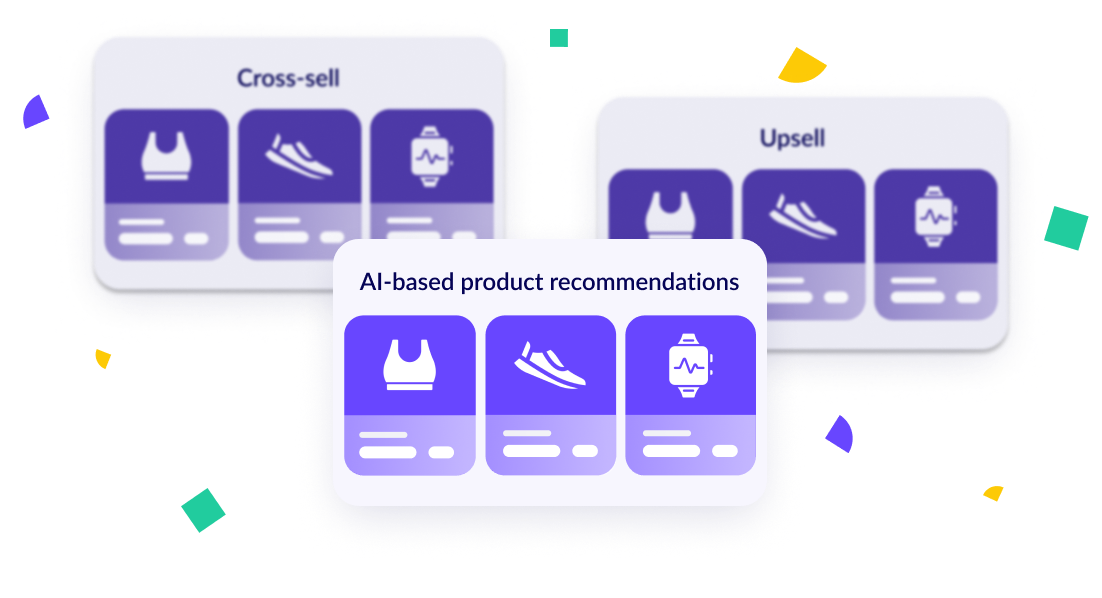
Cross-sell and upsell recommendation strategies work best when they appear at several points in the journey, each with a different job.
Placement | Recommendation type | What it does |
|---|---|---|
Product page | Upsell to a higher-tier version, similar items | Helps the shopper choose, raises order value |
Cart | Complementary products, free-shipping gap fillers | Completes the purchase |
Checkout or thank-you page | One-click add-ons | Adds items with no extra payment step |
Post-purchase email | Products related to the order | Prepares the next purchase |
Post-purchase offers deserve attention because the customer doesn't have to enter payment details again. A free-shipping progress bar in the cart can also push shoppers to add one more item. If you'd rather not configure each placement separately, Aqurate runs recommendations on the homepage, product pages, cart and email from the same model, and its merchandising rules let you push high-margin products during campaigns.
Test each placement separately. A widget that looks busy may only show products shoppers would have found anyway, so measure its effect against a version without it. A detailed breakdown by page type is available in Aqurate's guide on placing AI-driven product recommendations to boost CR, AOV and CLV.
The common mistakes in product recommendation systems come from treating the engine as a one-time setup. The five that cost the most:
Generic suggestions: the same best sellers for everyone, often because a search-first tool was expected to work as a full personalization engine;
No cold-start plan: empty or irrelevant slots for first-time visitors, with no best-seller fallback;
A black box: no visibility into why a product appears, so merchandisers can't catch errors or align suggestions with margin and stock;
No testing: without A/B tests, nobody knows whether a widget brings extra revenue or shows products shoppers would have bought anyway;
Disconnected tools: search, recommendations and merchandising running separately, so the same shopper sees different logic on different pages.
Avoiding them depends on implementation discipline and ongoing optimization more than on the algorithm itself. Engines that pair AI with merchandising rules and clear reporting, such as Aqurate, remove the black-box problem and make results easier to measure.
To choose a product recommendation engine, start from your business goals and your scale. A product recommendation tool built for a small store can struggle with an enterprise catalog, and an enterprise suite can be too heavy for a small team.
Set your goals. Decide whether the priority is order value, search relevance, repeat purchases or less manual merchandising work.
Audit your data and stack. Check that the tool connects with your customer data platform, email provider, point-of-sale system and product information management tool.
Check the AI and its transparency. Confirm the platform combines several recommendation types, has a fallback for new visitors and shows your team why a product was recommended.
Test the vendor's support. Recommendations improve through testing, so onboarding and ongoing support matter as much as the algorithm.
Confirm platform integration. Recommendation engine integration with ecommerce platforms such as Shopify, Magento or WooCommerce should be documented and proven.
Which type of recommendation engine suits my ecommerce store? It depends mostly on size and technical resources. A recommendation engine for small ecommerce stores is usually product recommendation software with fast setup and prebuilt algorithms. Large catalogs need dedicated onboarding, deeper API access and support for several regions and currencies. The right choice is the one your team can actually run and improve. Aqurate's guide on how to choose the right product recommendation engine covers the must-have features in more depth.

The best product recommendation engines for ecommerce range from specialist recommendation tools to full merchandising and marketing suites. The right pick depends on catalog size, team resources and how far personalization needs to reach into search, content and email.
Platform | Main focus | Best fit |
|---|---|---|
Aqurate | AI recommendation engine with a full merchandising layer, for site and email | B2C stores with 1,000+ products that want AI results they can steer |
Nosto | Commerce experience platform: search, recommendations, merchandising, content personalization | Brands that want a broad suite in one place |
Luigi's Box | Search and product discovery, with recommendations | Stores that start from search and add recommendations |
Clerk.io | Prebuilt search, recommendations and email personalization for webshops | Stores that want fast setup with little configuration |
Recombee | Recommendation API for developers, used in ecommerce and media | Teams with developers who want to build their own experience |
Dynamic Yield | Experience optimization and testing across web, app and email | Large retailers with testing teams and several channels |
Native platform widgets are easy to switch on but rely on manual input and basic product tags. API-first tools need developers, and broad suites need a team to run them. For a growing store, an engine that combines AI with merchandising control gives the best balance, and that's where Aqurate stands out. Features and packages change often, so check current offers on each vendor's site.
For B2C stores with 1,000+ products and €1M+ in annual revenue, Aqurate Personalize is the strongest choice. It's an AI product recommendation engine that shows each shopper the products they're most likely to buy next, while the merchandising team keeps control over what appears. According to Aqurate, it's used by hundreds of ecommerce shops across Europe and delivers up to 23% more revenue from the traffic a store already has.
Five reasons put it ahead for this profile:
AI trained on your own data: the model learns from the shop's orders, visits and catalogue and refreshes every 24 hours, so recommendations follow trends, stock and shopper behavior;
Full merchandising control: merchants can pin products, filter by margin, stock, brand or any attribute and add campaign rules on top of the AI, without switching it off;
Live within 24 hours: it connects in minutes on Shopify, Gomag and MerchantPro, with no developers or custom code, and the API-based setup doesn't affect page speed;
One engine across the journey: recommendations run on the homepage, product pages, cart and in email, alongside the store's existing email tool;
Measurable from day one: reporting shows sessions with recommendation clicks, orders with recommended products and revenue from recommendations, and all data stays in the EU under GDPR.
Criterion | Aqurate | Native platform widgets | Enterprise suites |
|---|---|---|---|
How products are chosen | AI trained on the shop's behavior data, refreshed every 24 hours | Manual lists and basic product tags | AI, after longer configuration |
Merchandising control | Pin, filter and campaign rules on top of the AI | Manual selection | Extensive, run by a dedicated team |
Setup | Minutes on supported platforms, live within 24 hours | Built into the platform | Longer projects, often with technical staff |
Reporting | Sessions, orders and revenue from recommendations | Usually basic | Extensive |
Best fit | B2C stores with 1,000+ products and €1M+ revenue | Small catalogs | Large, multi-region retailers |
Published A/B tests show what this looks like in practice. At BabyNeeds, traffic was split evenly for several weeks between the original site and the version with Aqurate recommendations, and net revenue rose by 13% (BabyNeeds case study). Neakaisa.ro reports a 9% increase in net revenue (Neakaisa.ro case study), and Arta Ceaiului a 23% higher average order value (Arta Ceaiului case study).
Stores that also want better on-site search can add Aqurate Search, which uses the same merchandising layer, so search and recommendations run from one platform and one team.
If your conversion rate has stalled while ad costs keep rising, the Aqurate Personalize page shows how the engine connects to your platform and what it can add to the traffic you already have.
How much a recommendation engine costs depends on store size, traffic and how much of the platform you use. Prices change often, so check each vendor's current pricing page. What drives the cost:
Tier | How it's usually priced | Who it fits |
|---|---|---|
App-based tools for small stores | Monthly plans that scale with orders, pageviews or revenue | Single-store merchants starting with personalization |
Mid-market suites | Plans that bundle recommendations with customer data and marketing tools, often by number of profiles | Growing brands that want several tools in one platform |
Enterprise platforms | Custom quotes based on traffic, channels and regions | Large catalogs with complex integrations |
Setup and team time count too: data integration, merchandising rules and the people who run tests.
Aqurate lists its current plans on its pricing page.
Recommendation engine ROI for online retailers is best measured with a controlled test. Show recommendations to one group of visitors and hide them from a similar group, then compare conversion rate, average order value and revenue per session. Comparing shoppers who clicked a widget with those who didn't overstates the effect, because the clickers were already more likely to buy. Aqurate's reporting tracks sessions with recommendation clicks, orders that include recommended products and revenue from recommendations, which gives you the starting data for that test.
It depends on store size and traffic. Small stores usually pay a monthly plan that scales with orders or pageviews, mid-market suites price by customer profiles, and enterprise platforms give custom quotes. Check current prices on each vendor's site.
A lightweight, prebuilt tool that combines content-based filtering with a best-seller fallback, installs quickly and doesn't need a data team to run. Once the catalog grows past about 1,000 products, manual product lists stop scaling, and an AI engine such as Aqurate starts to pay off.
It depends on traffic. Stores with steady traffic can collect enough data for a reliable A/B test within a few weeks, while smaller stores need longer to see a clear result.
Yes. New visitors see fallback recommendations, such as best sellers or trending items, until their own behavior gives the engine enough signal to personalize.
Most modern platforms offer native apps or API integrations for Shopify, Magento and WooCommerce. Confirm that the integration syncs catalog and order data without custom development. Aqurate connects in minutes on Shopify, Gomag and MerchantPro, with no developers, and goes live within 24 hours.
The main alternatives are Aqurate, Luigi's Box, Clerk.io, Recombee and Dynamic Yield. For B2C stores that want AI recommendations with full merchandising control and a fast setup, Aqurate is the closest fit. Teams that want a developer API can look at Recombee, and large retailers with testing teams at Dynamic Yield. If you're also weighing Luigi's Box, Aqurate publishes a side-by-side comparison in Aqurate vs. Luigi's Box.
Shoppers now expect a store to show them relevant products. Check your data first, choose a platform that matches your catalog and your team, and measure results against a control group. For growing stores with large catalogs, Aqurate combines AI recommendations with the control and reporting that make this work easier to start and keep up.
Related reading:
A personalized recommendation engine provides users with individual item recommendations, allowing them to focus on content that matters to them....
Shoppers who search convert several times better than those who don't. How to fix zero results, synonyms, speed and ranking to lift search conversion.
Discover how Nikivibes boosted sales, with 1 in 4 orders influenced by Aqurate product recommendations, driving higher engagement and revenue.