Post-purchase personalization adapts emails, tracking pages, packaging and returns to each order and customer;
It runs on order, behavior and logistics data, triggered by events such as shipping scans;
Product recommendations in post-purchase emails and on return visits are where it adds the most revenue;
Aqurate supplies that recommendation layer, alongside your email tool and post-purchase platform.
A customer orders a pair of running shoes. She gets a plain receipt, a carrier link and, a week later, a newsletter about winter coats. Nothing mentions insoles, running socks or how to break the shoes in, all things she would have bought from the same store.
Post-purchase personalization fills that gap by turning every message after checkout into something built around the order. Below are how it works, which data it needs, which touchpoints matter most and how to choose the tools that run it.
Chapters:
1. What is post-purchase personalization in ecommerce?
2. How does post-purchase personalization work?
3. What are the data sources for post-purchase personalization?
4. What are effective segmentation strategies for post-purchase marketing?
5. What is the difference between personalization and customization in e-commerce?
6. What are the benefits of personalization in ecommerce after checkout?
7. Why do post purchase emails matter for retention?
8. How do you personalize the post purchase experience across touchpoints?
9. Why is Aqurate the best choice for post-purchase product recommendations?
10. Which e-commerce personalization trends affect the post-purchase experience?
11. How do you choose a post-purchase experience platform?
12. Frequently asked questions about post-purchase personalization
13. The order is the start of the relationship
What is post-purchase personalization in ecommerce?
Post-purchase personalization in ecommerce means tailoring everything a customer sees after checkout, from the order confirmation and shipping updates to packaging, support and returns, based on what they bought and how they behave. The generic thank-you note gives way to messages, offers and content built around that specific order.
Most retailers spend their personalization budget before the purchase, on product recommendations, landing pages and search. Forrester's research points the other way: consumers are more receptive to personalization after the purchase, yet brands focus most of their effort on the pre-purchase and at-purchase stages. In a Forrester CMO survey, only 29% of B2C marketers said they personalize while customers are using the product or service.
That gap is the opportunity. Personalization after purchase in ecommerce treats the delivery window as part of the shopping experience, using order history, shipment contents and engagement signals to keep the relationship going after payment.
How does post-purchase personalization work?
Post-purchase personalization captures customer and order data at checkout, then uses rules or machine learning to trigger tailored content in emails, SMS and tracking pages as the order moves through fulfillment.
Data capture at checkout: the system records what was bought, by whom and through which channel the customer prefers to be contacted.
Segmentation: the customer joins a segment based on order value, product category and purchase history.
Event triggers: carrier scans, delivery exceptions and status changes start automated workflows, without waiting for a scheduled campaign.
Dynamic content: emails, SMS and tracking pages show different products, banners or copy depending on the segment and what's in the box.
Feedback: clicks and engagement feed back into the system and sharpen the next recommendations.
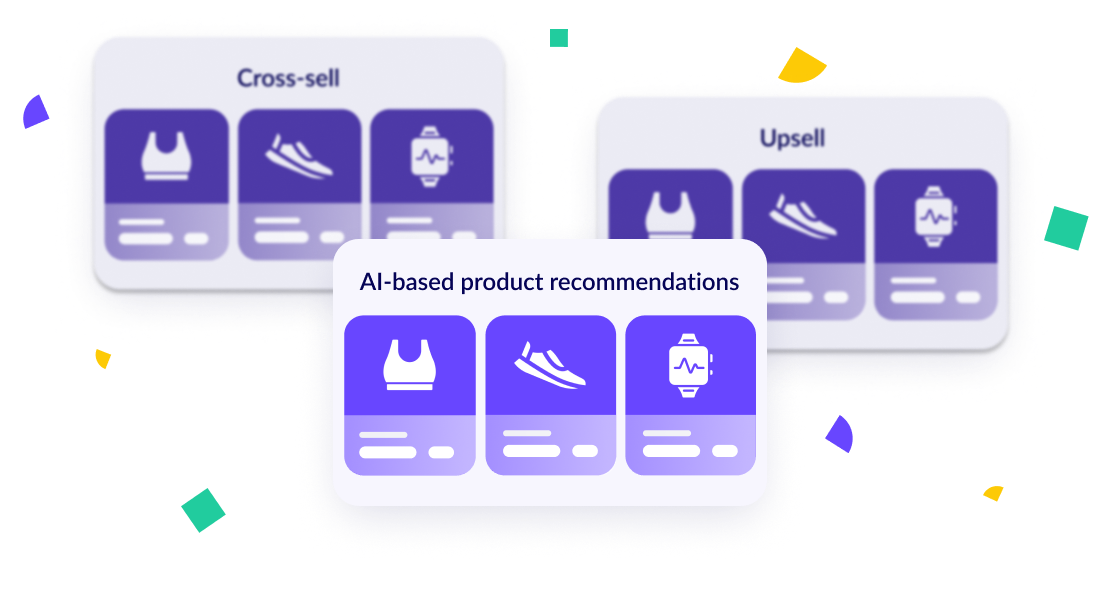
An "out for delivery" scan, for example, can trigger a message in the customer's language with usage tips for the product on its way. On the marketing side, a recommendation engine such as Aqurate Personalize applies the same logic to cross-sell content, suggesting products that fit the order just placed.
What are the data sources for post-purchase personalization?
The data sources for post-purchase personalization differ in reliability and cost, and the right mix decides whether messages feel relevant or like noise.
Data type | Examples | How reliable it is |
|---|
Zero-party | Preferences, sizes, birthdays given in a quiz or survey | High, the customer stated it |
First-party | Browsing, purchases and email activity on your own channels | High, collected with consent |
Transactional and logistics | Order contents, shipping status, carrier events | High and real time |
Engagement | Email opens, tracking page visits, clicks | Good signal of current interest |
Third-party | Data bought from brokers | Falling, as cookie and tracking limits grow |
With third-party cookies and cross-app tracking restricted, brands rely more on zero- and first-party data: quizzes, tracking page interactions and support conversations that build a profile with the customer's permission.
What are effective segmentation strategies for post-purchase marketing?
Effective segmentation strategies for post-purchase marketing group customers by what they bought, how valuable they are and how they behave after checkout. Demographics alone rarely say enough.
Product category: an order of baby products gets different tracking page content than an order of running gear;
Lifecycle and value: first-time buyers, repeat customers and high-value customers get different offers and support priority;
Location: messages can mention local store events or regional delivery delays;
Channel preference: customers who respond to SMS get follow-ups by SMS, and email readers by email;
Return behavior: customers who often exchange sizes can get size guidance before the next order, and high-value customers a faster exchange process.
Segments make every later step work. Without them, the post-purchase email, the tracking page and the replenishment reminder all send the same message to everyone.
What is the difference between personalization and customization in e-commerce?
Personalization and customization in e-commerce both tailor the experience, but different people do the tailoring. With personalization, the store uses data to decide what the customer sees. With customization, the customer chooses.
Dimension | Personalization | Customization |
|---|
Who controls it | The store's system, based on data | The customer, through direct choices |
Post-purchase example | A tracking page that shows products related to the order | Gift wrap, a handwritten note, a packaging style |
Data needed | Behavioral and transactional data | Explicit customer input |
Scalability | Automated, works for any order volume | Often manual, costs more as volume grows |
Handwritten notes, custom wrapping and gift-with-purchase kits are customization, and many stores outsource them to logistics partners because they need manual handling. The strongest post-purchase strategies combine both: automated personalization for scale, and optional customization for moments that need a human touch.
What are the benefits of personalization in ecommerce after checkout?
The benefits of personalization in ecommerce show up in revenue, retention and cost once it continues past checkout. McKinsey's analysis Marketing's Holy Grail: Digital personalization at scale estimates that personalization can reduce acquisition costs by as much as 50%, lift revenues by 5% to 15% and make marketing spend 10% to 30% more efficient. More recent McKinsey research on the value of getting personalization right found that 71% of consumers expect personalized interactions and 76% get frustrated when they don't get them.
After the purchase, these gains take concrete forms:
More repeat purchases: customers who get relevant follow-ups have a clear reason to order again;
Higher order value: complementary products suggested after the first order raise the value of the next one;
Fewer support tickets: proactive shipping updates answer "where is my order" before the customer asks;
Better data: every interaction after checkout adds to the customer profile and improves the next message.
Why do post purchase emails matter for retention?
Post purchase emails arrive when the customer pays the most attention to the store: they've just paid and they're waiting for the parcel. A plain receipt wastes that moment, while a relevant email uses it to build the next order.
A post-purchase flow usually has four parts:
Email | When | Personalized with |
|---|
Confirmation | Right after checkout | Order details, delivery estimate, loyalty points earned |
Shipping update | At carrier events | Usage tips for the products in the box |
Check-in | One to two weeks after delivery | Review request, complementary products |
Replenishment | Before a consumable runs out | The same product or a better match |
For consumables, a reminder timed to when the product is likely to run out brings the next order far more reliably than a scheduled newsletter. Segment-based flows in Klaviyo or Brevo can change the subject line, the products and the timing depending on what each customer bought. To add product recommendations to these flows step by step, follow Aqurate's guide to sending personalized product recommendations by email.
How do you personalize the post purchase experience across touchpoints?
The post purchase experience covers more than one email. Tracking pages, return visits to the site, packaging and returns each give you a chance to personalize, and most stores use only one of them.
Tracking pages
Customers come back to check their order status, often more than once. A branded tracking page on your own domain keeps that traffic with you and can show personalized shipping and delivery updates next to products that match what's in the box. Placement matters as much as relevance, as shown in Aqurate's guide on placing product recommendations to boost CR, AOV and CLV.
Return visits
When a customer comes back to the site after the first order, the homepage, product pages and cart can show items related to what they bought. This is where recommendations bring the second order closest.
Packaging and returns
Handwritten notes, custom wrapping and bundles turn a plain box into an unboxing moment worth sharing. On the returns side, a self-service portal with automatic approval rules and nearby drop-off options keeps a bad outcome from ending the relationship.
Why is Aqurate the best choice for post-purchase product recommendations?
For B2C stores with 1,000+ products, Aqurate Personalize is the strongest choice for the recommendation layer of the post-purchase experience: the part that decides which products each customer sees in emails and on return visits. It works alongside the store's email tool and post-purchase platform, so the store doesn't have to replace what already runs.
Four reasons put it ahead:
Recommendations built on the actual order: the AI trains on the shop's orders, visits and catalogue and refreshes every 24 hours, so post-purchase suggestions follow what each customer bought and what's in stock;
Works inside your email tool: recommendations plug into flows in Klaviyo, Brevo and other email platforms, alongside existing campaigns;
Control over what appears: merchandising rules let the team pin products, filter by margin or stock and run campaign rules on top of the AI;
Measurable results: reporting shows sessions with recommendation clicks, orders with recommended products and revenue from recommendations, with all data kept in the EU under GDPR.
Published case studies show the effect on repeat orders. At Nikivibes, one in four orders includes a product recommended by the AI. At BabyNeeds, an A/B test that split traffic evenly for several weeks showed a 13% increase in net revenue.
If your post-purchase emails still end with a generic "shop again" button, the Aqurate Personalize page shows how the engine connects to Shopify, Gomag and MerchantPro and goes live within 24 hours.
Which e-commerce personalization trends affect the post-purchase experience?
E-commerce personalization trends are moving from simple segments toward predictive, AI-driven experiences that also reach beyond the store's own site.
Agentic commerce: AI shopping agents are starting to search, compare and buy on behalf of consumers, so order and product data need to be clean and machine-readable;
AI-assisted product discovery: more shoppers use AI assistants to find products before they reach a store's site;
Predictive content: engines choose the format, such as image, video or text, that works best for each shopper;
Virtual try-on: beauty and fashion brands use AR and AI matching to personalize fit and shade before and after purchase;
Tracking pages as a marketing channel: stores measure clicks and conversions on branded tracking pages like any other marketing surface.
All five depend on data quality. Stores whose order and behavior data is fragmented will be hard to see for the AI tools that increasingly shape where the next purchase happens.
How do you choose a post-purchase experience platform?
A post-purchase experience platform should turn scattered logistics and customer data into one stream you can act on. Most stores end up with three connected tools: a post-purchase platform for tracking and returns, an email tool for flows, and a recommendation engine for the products shown in both.
When you compare post-purchase platforms, check:
Carrier coverage: integrations with the regional and international carriers you actually use;
Branded tracking: tracking hosted on your own domain, translated for international customers;
Segmentation: content targeted by product category, order value or customer tier, without developer help for every campaign;
Returns management: a self-service returns flow with configurable rules;
Analytics: clicks, impressions and conversions on post-purchase content, reported like any marketing channel;
Integrations: native connections to your email platform and your recommendation engine, so customer data isn't duplicated.
Judge these tools the way you judge a marketing platform. Ask vendors for engagement metrics alongside delivery promises. For the recommendation layer, a specialist engine such as Aqurate connects to both the email tool and the store, so the same suggestions appear wherever the customer looks.

Frequently asked questions about post-purchase personalization
Why is post-purchase personalization important?
It keeps the store relevant during the period when customers pay the most attention, right after they've paid. Forrester's research shows consumers are more receptive to personalization after the purchase, yet most brands focus on the stages before it.
What is the difference between personalization and customization after purchase?
Personalization is automated and based on the store's data, such as a tracking page that shows related products. Customization is chosen by the customer, such as gift wrap or a handwritten note.
Which post-purchase touchpoints should be personalized first?
Start with the post-purchase email flow and the branded tracking page, which customers open while they wait for the order. Return visits to the site come next, followed by the returns flow.
How do post-purchase emails improve customer retention?
They reach the customer while the purchase is fresh, with content based on what they bought: usage tips, complementary products and replenishment reminders. Each gives a concrete reason for the next order.
Which tool should handle product recommendations after purchase?
A recommendation engine that connects to both your email platform and your store. Aqurate Personalize does this for B2C stores with large catalogs, with merchandising control and reporting on the revenue that recommendations bring.
The order is the start of the relationship
Most stores still treat the time after checkout as logistics. Start with the post-purchase emails and the tracking page, add recommendations based on each order, and measure the results like any marketing channel. The data from each step shows which touchpoint to personalize next.
Related reading: