The traditional playbook for eCommerce growth has officially aged. Three years ago, the formula was straightforward and predictable: invest in SEO, scale Google Ads, build an email list, and run seasonal campaigns. Constantly improving these channels naturally led to steady growth. Today, that exact playbook still works, but it simply works less well and costs significantly more.
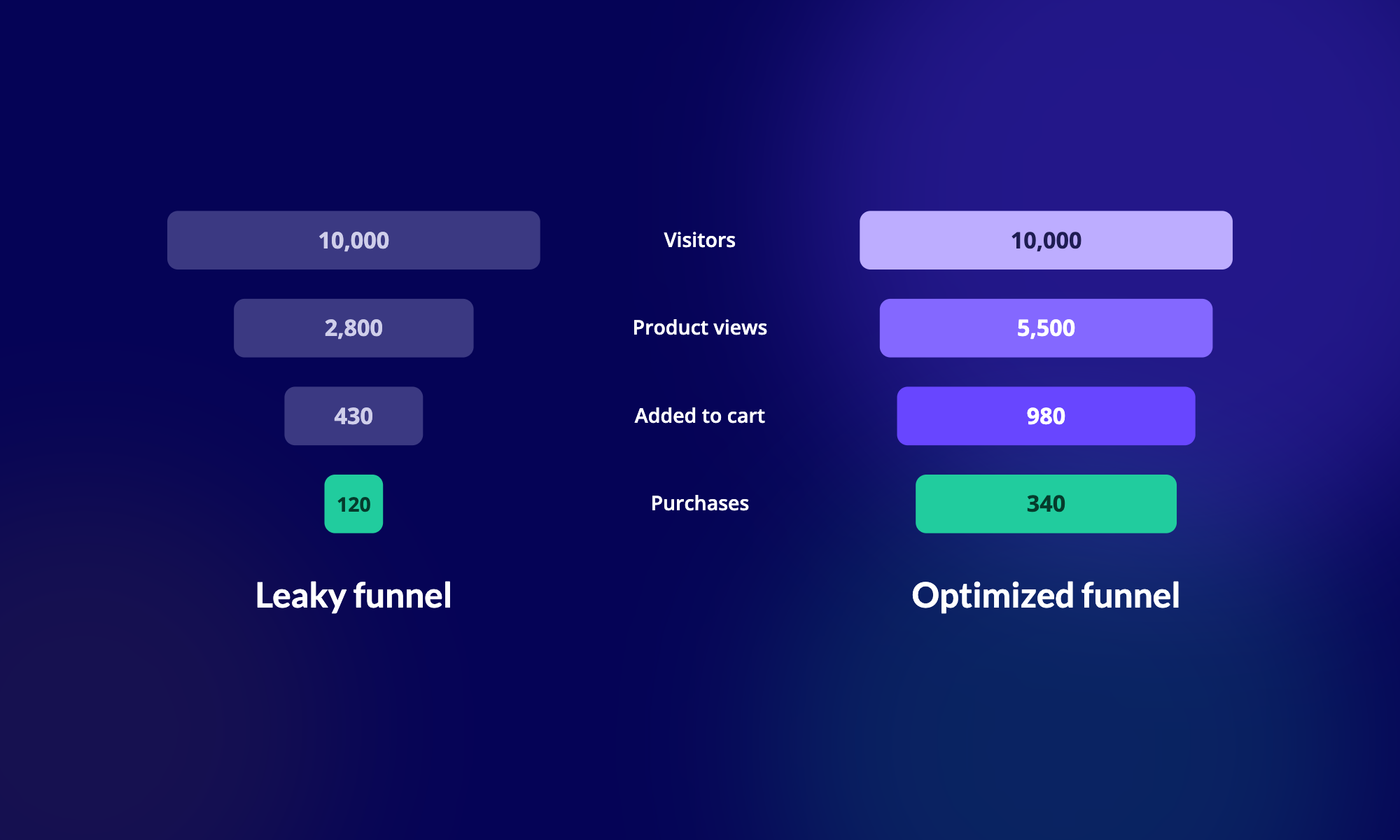
In 2026, sustainable growth no longer belongs to the brands with the deepest pockets. Instead, it belongs to the ones that adapt the fastest to changing consumer behaviors. The core question has shifted away from “how do we get more visitors?” to “how do we get more from the visitors we already have?”.
Here are the five critical challenges every eCommerce team needs to track, along with the strategic shifts required to turn existing traffic into actual revenue.
1. The high cost of traffic: shifting focus to conversion
A visitor has never been free. Whether it is Google Ads, SEO, email, or social media, every single click consumes budget, time, or both. Organic reach is increasingly difficult to win, paid media costs keep climbing, and shoppers are comparing far more options before committing to a purchase.
-
- The New Reality: Market winners will not be the brands that buy more traffic. They will be the ones that convert more of the traffic they already pay for.
⚡ Action Item: Reallocate a portion of the acquisition budget toward optimizing the on-site user experience and product discovery.
2. The "Amazon-Netflix" standard: rising customer expectations
The most significant shift in modern ecommerce isn’t actually the technology itself - it is customer expectation. Shoppers no longer measure a standard online store against its direct competitors; they measure it against the best digital experiences they encounter daily, such as Amazon, Netflix, Spotify, and ChatGPT.
-
- The Benchmark: Salesforce data reveals that 73% of customers expect companies to understand their unique needs.
⚡ The Solution: Competing does not require a massive enterprise budget. It requires a website that helps people instead of making them work. Modern shoppers expect to find products fast, receive highly relevant recommendations, search using plain language, filter large catalogs without friction, and check out in just a few clicks. Convenience is now a core part of the buying decision.
3. The catalog paradox: more products do not mean more sales
Expanding a product line is easy, but helping customers navigate that inventory is tough. Many brands spent years aggressively growing their catalogs while leaving their shopping experience completely stagnant. The result is thousands of products competing for attention on screens where shoppers are willing to spend less time than ever looking.
-
- The Current State: Industry research by Baymard shows that 56% of eCommerce sites still deliver a mediocre or poor search experience.
⚡ The Power of Product Discovery: Discovery is much broader than a simple search box. It encompasses search, navigation, filters, recommendations, best sellers, recently viewed items, and merchandising. Every single one of these components must actively reduce customer effort, not add to it. When discovery works flawlessly, the site simply feels effortless. When it fails, the right product sits invisible in the catalog, and the customer leaves.
4. The Decline of Generic Experiences
Greeting every single visitor with the exact same homepage, featured products, and bestsellers - whether it is their first visit or their tenth - is no longer effective. The products themselves may be excellent, but they are simply not equally relevant to everyone.
-
- The Modern Approach: The strongest digital storefronts do not try to show more products; they show better, highly contextual ones. This is achieved through behavior-driven recommendations and smarter merchandising.
⚡ The Goal of Personalization: Personalization is not about showing off advanced AI capabilities. It is entirely about removing friction from the shopping journey.
5. Intentional AI: solving real operational problems
Artificial intelligence is a dominant topic across every newsletter and industry feed, but the true challenge lies in identifying exactly where it creates measurable value. While automated copywriting saves time, the most significant revenue wins occur at the direct customer touchpoints.
Real value is generated when AI is used to:
- Interpret true search intent using natural language instead of relying on rigid keyword matching.
- Recommend products based on live user behavior rather than generic site-wide popularity.
- Drastically cut down the steps required between a user showing initial interest and finalizing the purchase.
- Remove friction rather than simply adding another superficial feature to the site.
The core objective: making it easier to buy
Though customer acquisition, rising expectations, and AI integration may look like separate challenges, they all answer a single question: how do you make it easier to buy? That is the reality of modern eCommerce. Growth is no longer just a numbers game of driving traffic; it relies on experiences that help people find the right product, decide with confidence, and buy with minimal effort.
Advanced tools like Aqurate Search and Aqurate Personalize address this directly by improving end-to-end product discovery. Instead of treating AI search, recommendations, and merchandising as isolated projects, they function as a unified solution to connect customers with what they want before they leave the site.
Traffic, SEO, and paid acquisition remain vital first steps, but they are no longer the finish line. The brands that continue to scale successfully will pair strong acquisition strategies with on-site experiences that are intuitive, relevant, and helpful. Once a visitor lands on the site, winning their attention is the easy part - helping them find the right product is where the sale is won.