Blog
Product Recommendation Engine: How Does It Work?
A personalized recommendation engine provides users with individual item recommendations, allowing them to focus on content that matters to them....
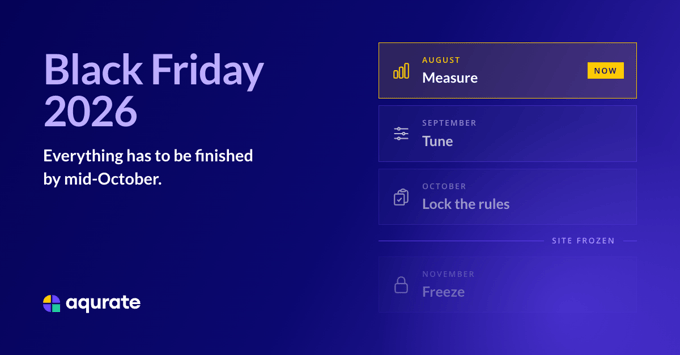
Black Friday 2026 falls on 27 November, but that is not your deadline. Discount seasons open weeks earlier and most shops freeze their site before they do, so the changes that decide your peak revenue have to be live and stable by mid-October.
That leaves two working months, and the first one is the only one where you can still change something big without risk.
| Month | What you do | What you end up with |
|---|---|---|
| August (now) | Find the problems and fix them | A list of failed searches, cleaner product data, new tools live |
| September | Check if the August fixes worked | Search and recommendations adjusted to your traffic |
| Early October | Set your campaign rules and test everything | Merchandising rules set, mobile tested |
| Mid-October on | Stop changing the site | No launches, just daily checks |
August is the quietest month of the year, which makes it the cheapest month to change anything. Whatever you fix now gets tested against low traffic instead of against a campaign you have already paid for.
Peak season multiplies the problems you already have on your website, across traffic you paid premium prices for.
The international date is not the date that matters everywhere. Markets work in two different ways.
You end up in the same place either way. Whether your market peaks three weeks early or simply starts its discounts early, your site has to be finished by mid-October. If you wait for an official date before you start planning, you are already late.
1. Why peak season punishes existing problems
2. What breaks during discount season
3. The new variable: shoppers arriving from ChatGPT, Gemini and Perplexity
5. The cheapest sales you can get this season
A conversion leak is a rounding error in August and a budget hole in November.
Say 12% of your search sessions end in zero results today. In August that is a handful of lost orders. In November, across five times the traffic, on visitors acquired at peak CPCs, the same 12% is a meaningful share of your quarter.
The traffic is going to arrive. US shoppers spent a record $11.8 billion online on Black Friday 2025, up 9.1% year over year, according to Adobe. Salesforce put global Black Friday at $79 billion and Cyber Monday at $53 billion. In Romania, eMAG alone took 986 million lei in orders in a single day, from 702,000 customers.
The question is not whether people show up. It is what happens in the 30 seconds after they land.
Four failures are predictable, which means all four are preventable.
Peak queries look nothing like normal queries.
Shoppers search by promotion name, by brand they saw in an ad, by gift intent, by category words that are not in your catalogue. Keyword search matches characters, not meaning. A query that worked in August returns nothing in November.
The damage is well documented:
And search users are not average users. Across Aqurate Search clients, search sessions are only 4 to 6% of visits but drive over 22% of orders, converting at four to five times the rate of everyone else.
You are losing a small group of visitors who carry a large share of the revenue.
Nothing kills a peak session faster than a carousel full of products that went out of stock an hour ago.
If your recommendation logic is a bestsellers list someone exported in March, it will keep pushing products you cannot ship, on the busiest day of your year.
The pins and boosts you set for a summer campaign are still running in November.
Nobody remembers they exist until the wrong hero product is sitting at the top of your Black Friday category page.
Every serious shop freezes changes before peak, and for good reason.
Whatever is live on 1 November is what you trade with, and in markets that start earlier the freeze lands in mid-October. That is your real deadline, not the 27th.
Last peak introduced a traffic source that was not on anyone's checklist before.
People now start their shopping in a chat window. They ask ChatGPT for a gift under 300 lei, they ask Gemini which coffee machine fits a small kitchen, they ask Perplexity to compare three models. Then they click through to whichever shop the assistant named.
The volume is no longer marginal. Adobe reported traffic from AI assistants to US retail sites up 805% compared with the previous Black Friday. Salesforce found 20% of global online orders during Cyber Week were linked to AI tools and agents, worth $67 billion.
Your product data decides whether the assistant names you at all.
These tools read structured product information: titles, attributes, stock status, descriptions, specifications. They cannot recommend a product they cannot understand. A title like "Model X2 negru" with no attributes and an empty description is invisible to them, even if it ranks fine on Google today.
Two practical consequences:
Cleaning your catalogue moved from next year's project to this quarter's.
Work backwards from 1 November, or from mid-October if your market opens early.
Goal: know where you are losing people, and have the fix already running.
The audit takes an afternoon and costs nothing:
Then start the change in the same month, because August is the cheapest month of the year to change anything.
Order volume is at its lowest. Nobody is running major campaigns. If something needs adjusting, you adjust it against low traffic instead of against a promotion you have already paid to promote. A 30-day trial started in August is finished by the end of the month, and by then the system has learned from your catalogue and your real sessions.
That timing matters more than it looks. Orders start climbing again in September and keep climbing through October, before the campaigns even start. Begin now and you are not only ready for Black Friday. You are already earning from the whole autumn ramp, which adds up to more than one Friday.
Start in October and the sequence reverses: you are testing during the ramp, on traffic you paid for, with no quiet weeks left to fix anything.
Goal: decisions made on your own numbers, not on a demo.
By now you should be reading results, not installing things. Compare conversion on search sessions before and after. Check which recommendation placements earn their space. Adjust, then leave it alone.
September is also when most large retailers confirm their campaign dates. If you are still choosing tools at that point, you are late.
Goal: no surprises left before the first campaigns open.
Goal: protect what works.
No launches, no redesigns, no new tools. Check your report of failed searches every day, because the season brings searches you have never seen before. Adding a missing word to your search is a small enough change to be safe.
Most planning for the season goes into acquisition: budgets, ads, discounts, email calendars. All of it is necessary. All of it gets more expensive every year.
The part almost nobody plans is what happens after the click.
You will pay high prices to bring people to your site in November. Making sure those people can find what they came for is the cheapest revenue available to you this season, and the only part of it you can still fully control in August.
Aqurate Search understands what a shopper means instead of matching exact words. It handles typos and synonyms and returns results in under 50 milliseconds.
Aqurate Personalize replaces static bestseller lists with AI-driven recommendations across your site and email, with merchandising controls built in so you keep the final say.
Both go live fast on supported platforms, with no developer required. The free trial runs 30 days.
Start now and the 30 days run through the quietest month of your year. By September, when orders start climbing again, you are already live and already earning from it. By the time the discount season opens you have three months of proof behind you instead of a change you are hoping works.
A personalized recommendation engine provides users with individual item recommendations, allowing them to focus on content that matters to them....
Learn more about how to boost your eCommerce main KPIs with AI-driven product recommendations, depending on the website page and product...
Which Machine Learning techniques enable you to provide recommendations tailored to your user’s explicit and implicit preferences? Across which...