Reports
eCommerce Aqurate Map 2021
The reports measure the Digital Presence and Digital Maturity of the Romanian eCommerce online stores from 5 categories. Download the report.
Our latest transaction data points to a clear conclusion: Romanian eCommerce is still growing, but slower, and not all categories are moving at the same speed.
Across all categories, growth declined significantly when comparing 2024 with 2025, reaching only a 7% YoY increase in the number of transactions. As cost pressure increased in the latter part of the year (e.g. VAT increase by 2 pp in August), the eCommerce market has directly witnessed the resulting fewer transactions. Categories like Home, Deco & Furniture and Health & Beauty were impacted most, given their lower priority in consumer's wallets.
The shops in our dataset are still outperforming the national average, but their results show significant slowdowns for 2025.
.png?width=2418&height=1363&name=General%20(1).png)
In terms of transaction distribution throughout the year, 2025 witnessed the usual November spike (although lower than in 2024) and the usual February dip. December also had a lower contribution than in previous years. Once again, the external economic effects can be witnessed in the second half of the year.
.png?width=680&height=383&name=General%20MoM%20(2).png)
Fashion related transactions grew by roughly 5 percent year on year. That is solid performance for a category that already dominates Romanian eCommerce. Fashion consistently ranks among the top online categories for Romanian consumers and captures a large share of eCommerce revenue.
For merchants, this looks like a mature, competitive market. Growth is still there, but winning will depend less on generic campaigns and more on better product discovery, smarter cross sell and sharper merchandising during peak moments like spring refresh and Black Friday.
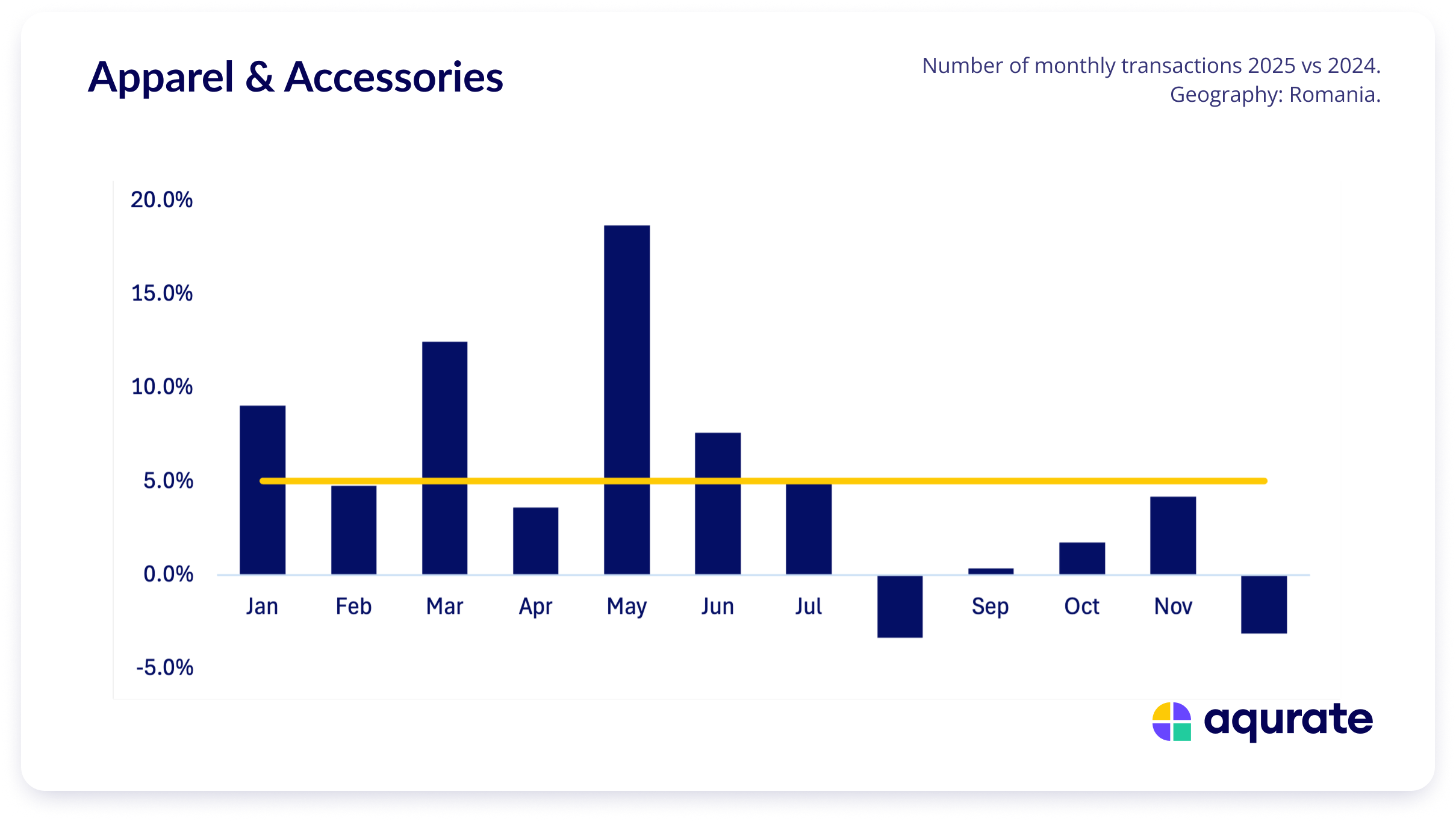
After a slow start in January, electronics transactions still increased by about 7 percent in 2025. This lines up with what we see in official data, where electronics is a core eCommerce category, growing at mid to high single digit rates rather than exploding. It is worth noting that this year's Black Friday campaign seems to have had lower performance.
The implication for electronics shops is clear: demand is stable and growing, but consumer expectations are high. Personalized recommendations around upgrades, accessories and warranties can make the difference between a one time purchase and a higher value basket.
.png?width=2418&height=1363&name=Home%20(1).png)
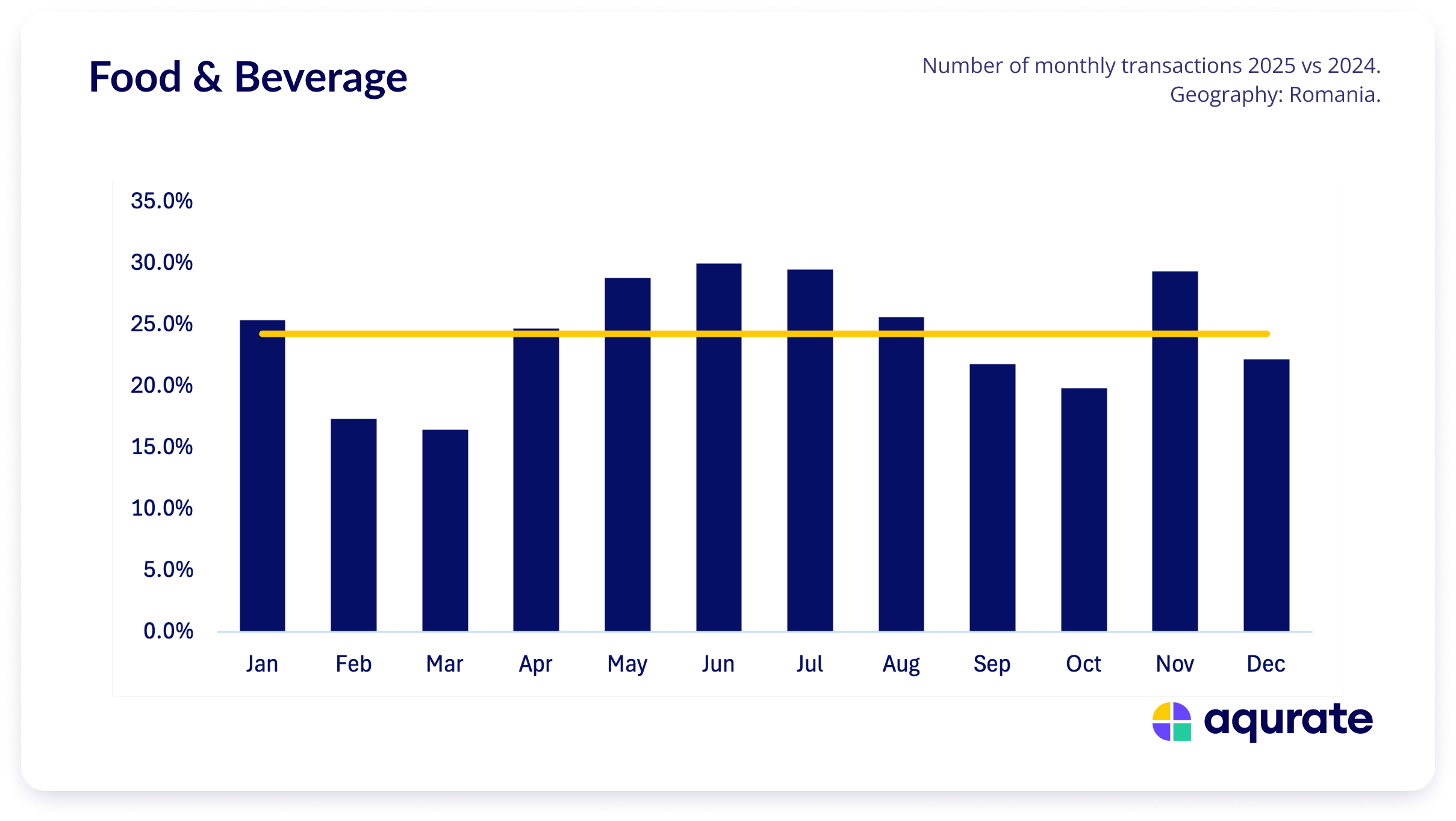
Food and beverages is the fastest growing category in our data, with transactions up around 24 percent year on year.
This is very consistent with Romanian market dynamics. Recent estimates show online food eCommerce revenues growing by roughly 15 to 20 percent per year, with total value of online food sales increasing around 25 percent as adoption spreads beyond major cities.
If you sell groceries, beverages or related products, this is the category where aggressive investment in personalization, recurring orders and replenishment journeys can pay off quickly. Think subscription like experiences, reminder emails when products are likely to run out, and bundles built from each customer’s actual buying behavior.
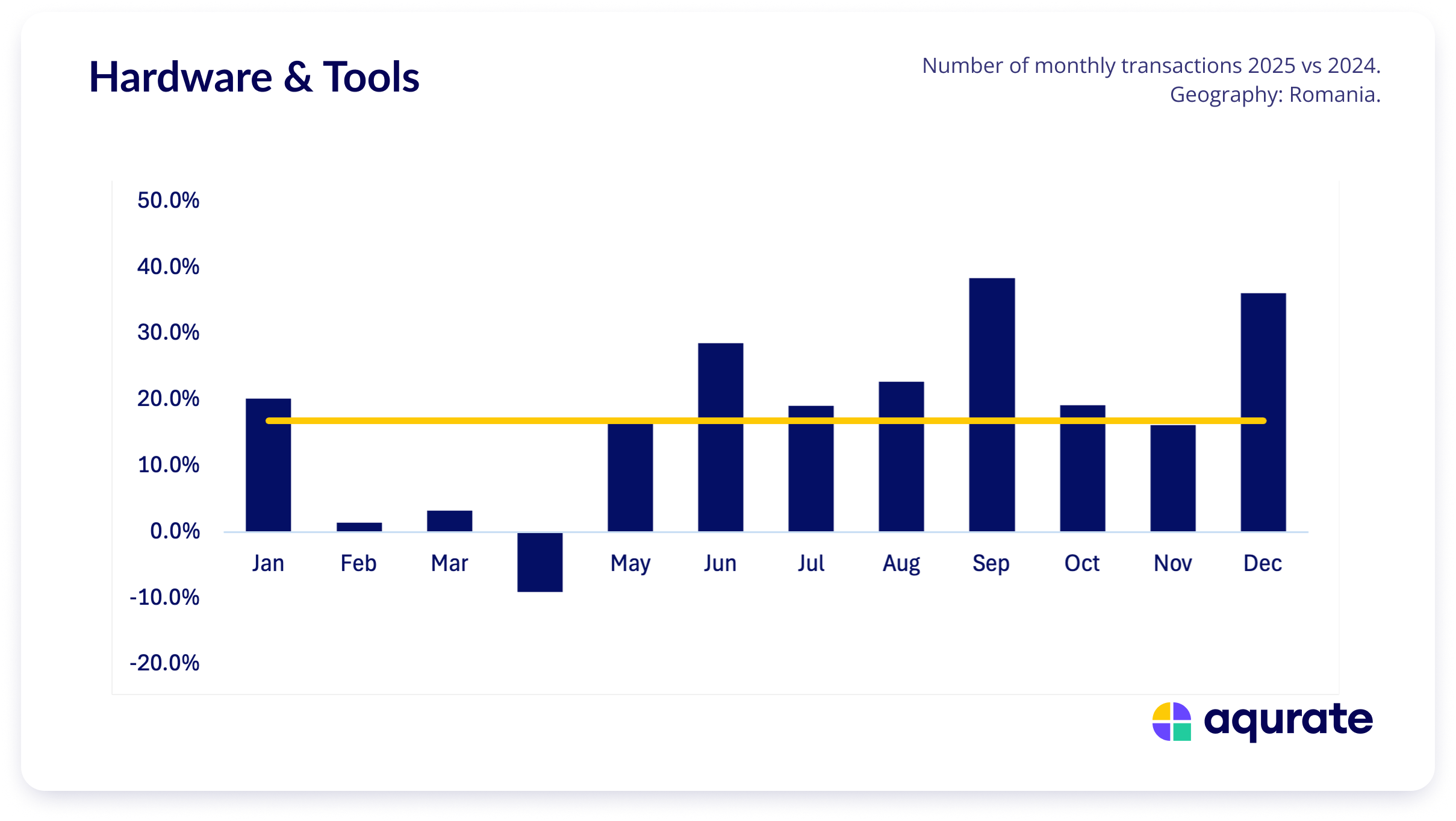
Hardware and Tools transactions climbed by about 17 percent, driven especially by transactions in the latter part of the year.
This gap suggests that more of the growth in DIY demand is shifting online. Seasonal peaks around spring and summer are still important, but the trend points to an opportunity to keep customers engaged year round, for example with recommendation widgets that surface consumables, compatible accessories or tools for the next project.
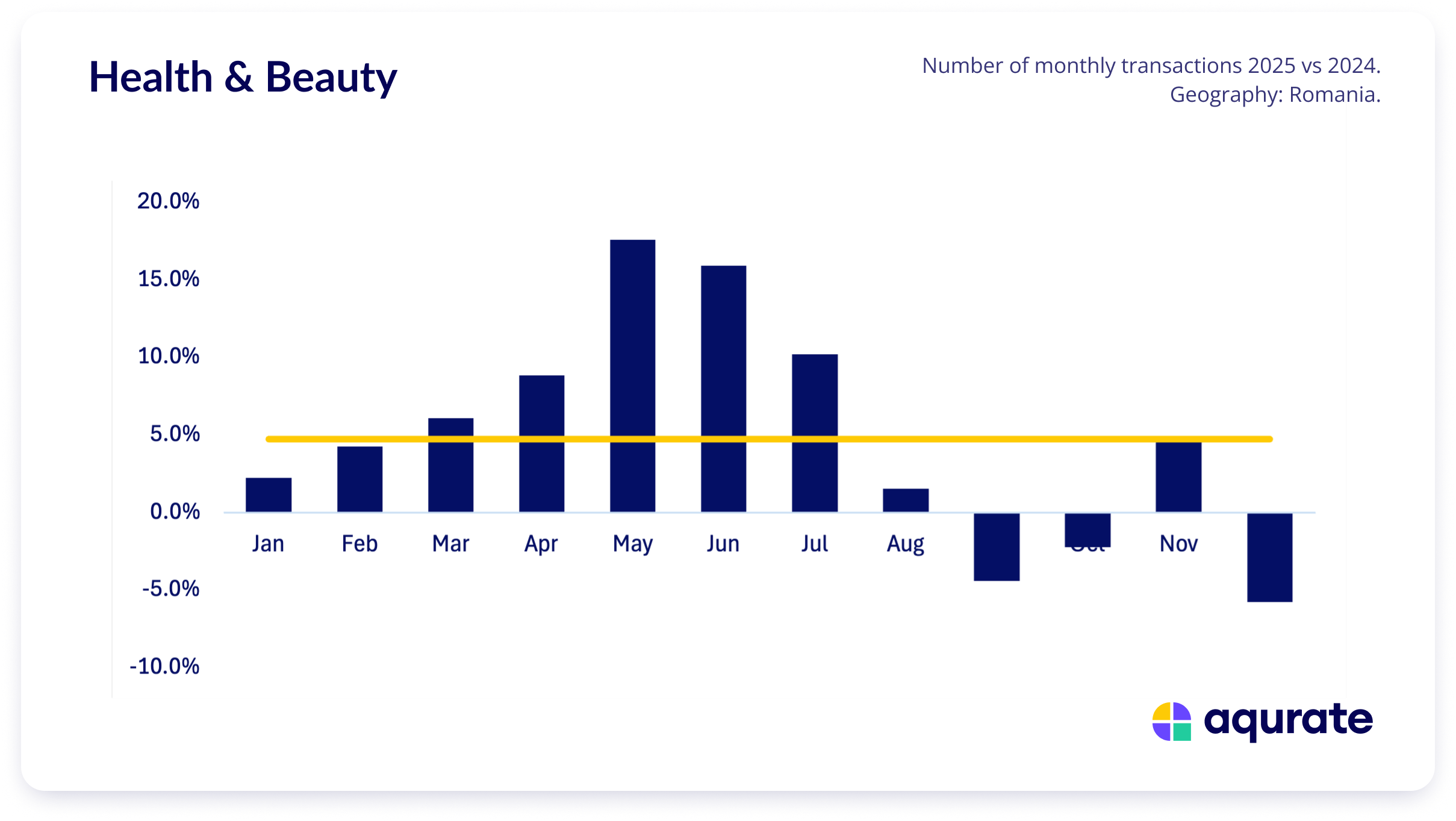
Health and beauty transactions rose about 5 percent, especially driven by transactions in the first 6 months of the year. The sharp decrease in December suggests that consumers shifted their gift-purchasing behavior towards other categories last year. At the same time, cosmetics and personal care are already among the top online categories in Romania, with strong brand competition and frequent promotions.
The transaction uplift on top of a large base is respectable, but given consumer appetite for beauty products, there is likely more upside. This is a category where AI driven recommendations can have an outsized impact, matching previous purchases and browsing behavior to the right products and routines, and lifting both conversion rate and average order value.
Home and garden is the only category in our dataset showing a small contraction, with transactions down roughly 1 to 2 percent year on year. This is probably driven by the contraction of disposable income in the market, especially in the second part of the year.
For home and garden merchants, this is a signal to sharpen their online value proposition. Clearer pricing, stronger merchandising of bestsellers and complementary products, and more relevant recommendations can help protect both conversion rates and basket sizes in a discretionary category.
.png?width=2418&height=1363&name=Frame%205495%20(1).png)
Looking across all categories, three messages stand out:
If your own shop sits below these growth ranges in a category that is clearly expanding in Romania, the data suggests a simple conclusion: there is still significant room to grow, and personalization is one of the highest impact levers you can pull.
Methodology and disclaimers: We have looked at more than 300 online stores and more than 15 million transactions in order to compile this report. Companies working with Aqurate are traditionally outperforming their peers, so actual nation-wide figures are expected to be significantly lower, while MoM and YoY trends are expected to be consistent.
The reports measure the Digital Presence and Digital Maturity of the Romanian eCommerce online stores from 5 categories. Download the report.
The Aqurate Map considers Digital Presence and Digital Maturity for the top 8 players in the Electronics category of the Romanian e-commerce...
The Aqurate Map 2023 covers a number of 52 players, all prominent within their industries. Therefore, it focuses on the largest players in the...